Friday, July 28, 2006

Fiberology 101: The Origin of Yarn

I am not sure if I have a yarn stash or a yarn infestation.

But I do have a working theory as to where yarn comes from.


Abstract:

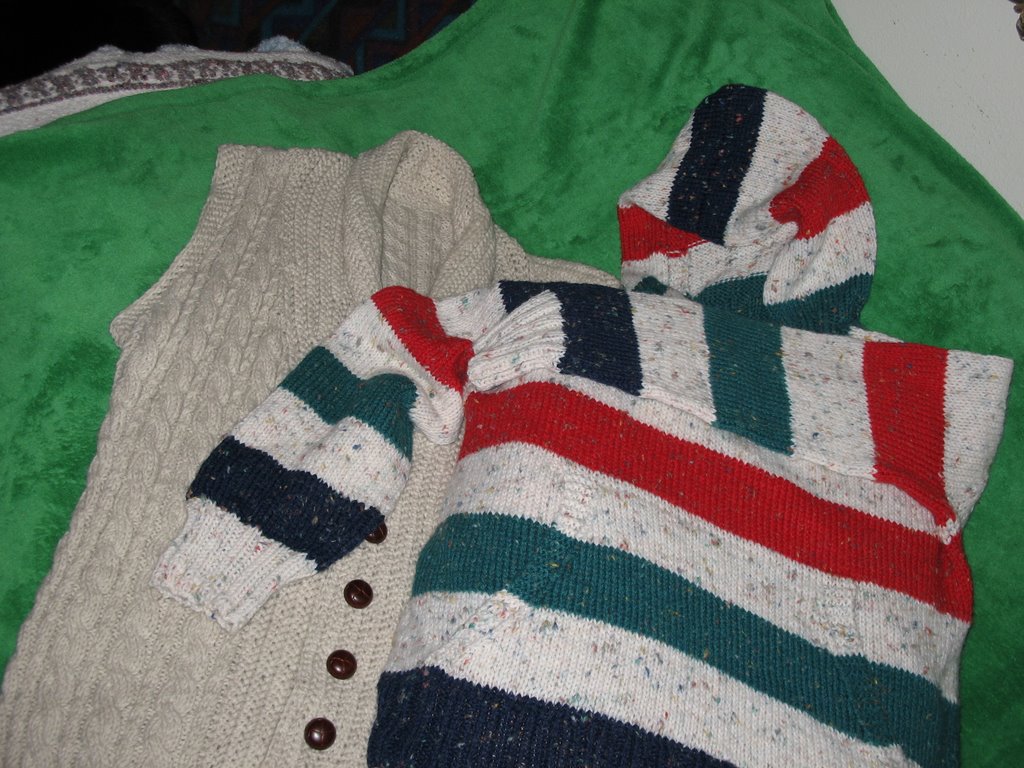
Yarn is actually garment larvae. I can prove this with these never-before seen photos of actual wool garments in full mating display. In the following photo, we can see the colorful male garment showing off his size and prowess while the less brightly plumaged female exhibits her willingness to copulate by lounging seductively and emitting wool pheromones:

In the second photo, the pair has been captured in the act of mating:


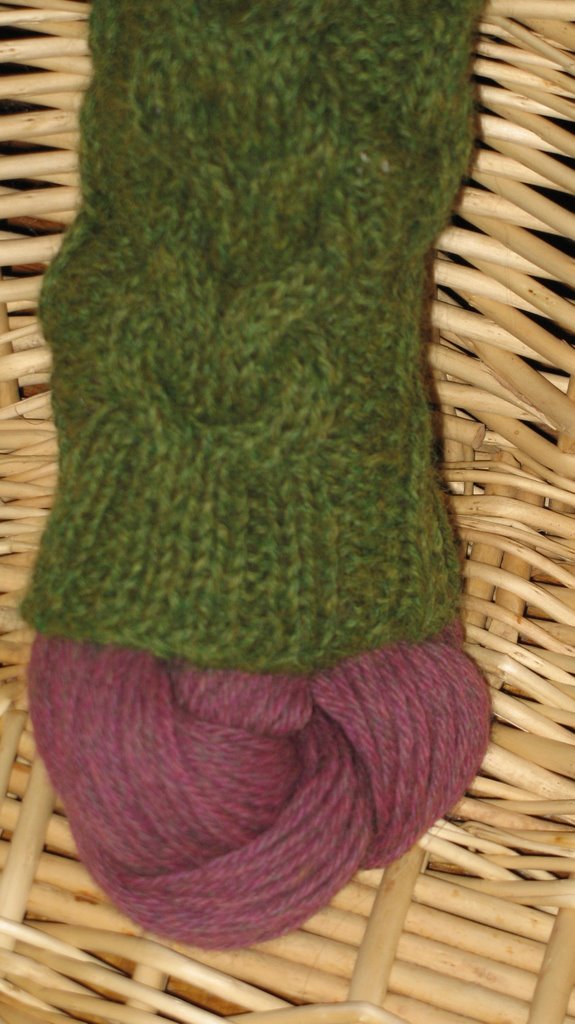
During gestation, the female hides in a dark closet until the eggs are ready to be laid, when she will seek out a suitable nesting site. The following photo shows a green-skinned subspecies in the egg-laying stage. She everts her highly elastic cloaca to allow a new skein of mauve-colored yarn to enter the world:


In selecting a nesting site, females tend to prefer empty plastic bags, boxes, bins, dresser drawers or baskets, with Rubbermaid tubs being preferred above all other nesting materials. However, in a pinch, females have been known to deposit eggs in coffee cans, backpacks, unused punchbowls, and luggage. In short, anyplace dark and quiet which isn't disturbed very often makes a good nesting spot.

Sometimes the same nest will contain eggs, larvae and pupae in several stages of development. My research team believes that the females, who are constantly in heat and who remain continuously fertile, return repeatedly to the same nesting spot over a period of time.

In the following photo, you will see a new "skein" -- the earliest developmental stage -- of bright green wool , freshly laid directly on top of several larvae in the "ball" stage. Apparently this female has mated with several different males, as determined by the variety of colors in this clutch:


Migrating females often select retail shops to deposit large clutches of eggs. Just as many birds often share the same nesting grounds, fiberologists believe that multiple nests of varied garment subspecies help assure the overall survival of the genus.

The female will lay anywhere from a single egg to hundreds. Eggs may closely resemble the adults of their species both in color and in texture, or they may vary wildly. The eggs can incubate anywhere from a few hours to several years before they enter the pupal stage and begin to make their chorus of faint, monotonous, but unmistakable maturity calls, which sound like:

"...nit-meee, nit-meee, nit-meee ..."

The persistent, low call attracts the species Lana knitterati, otherwise known as the common knitter, a species found in most parts of the world, who assist the garment larvae out of the pupal stage and through the metamorphosis into an adult garment. Most fiberologists believe that the repetitive motion of the knitter's hands actually plays a vital role in the metamorphosis from larvae to adult.

Lana knitterati are commonly found wherever sheep, llamas, silkworms, cotton, or garment larvae are present. The species originated in Central Asia, but due to human imperialism and the opening of trade routes and shipping lanes, these creatures have invaded every part of the planet, much in the same manner as domestic cats, the common house sparrow and Rattus rattus.

Subspecies include L. knitterati norvegicus, known for its striking geometric color patterns and L. knitterati gaelicus, a subspecies containing two major races: L. k. gaelicus aranii, easily recognized by the bold texture if its skin, and L. k. gaelicus fairisleii, which, although bearing strong color markings, can be distinguised from the norvegicus subspecies by repetitive X- and O-shaped markings within prominent color bands encircling the torso. Like most isolated island species with a common ancestor, several other races of L. k. gaelicus have developed, including the races of ganseyii and faroeseii.

May other subspecies exist throughout the world: a color-patterned variety known as intarsius, many races of laceii, and highly prolific strains of sockus, mittenus, and scarfus, which are considered invasive species in most parts of their range.

Among the laceii races, most fiberologists consider the sighting or capture of the rare orenbergus to be the field experience of a lifetime.

Many questions in the natural history of yarn remain unanswered by science -- especially the mysterious, and alarmingly frequent, tendency of garment pupae to simply stop development partly through the metamorphic process and to remain in stasis for indefinite periods of time. Sometimes, adult garment development spontaneously resumes after many weeks or years of stasis, but in many sad cases, development ceases entirely. Sometimes, the common knitter becomes involved at this stage -- in a magnificent display of Nature's abhorrence of waste, scavenging knitters actually unravel the partly-developed pupae. We continue to study this phenomenon.

These remarkable photographs remind us again of the interdependence of all species. Just as certain rainforest flowers have evolved so that they can only be pollinated by a single species of hummingbird ... yarn larvae could never develop into adult garments without the assitance of Lana knitterati, the common knitter.

-- Dr. Mambocat, PhD, BsFD, KD

Note to class: the next time Fiberology 101 meets, we will futher discuss the interdependence of yarn and garments with other species.

Thursday, July 27, 2006

Cheap Thrills ...

Look over there under the column of archives. Scroll down.

All the way to the bottom.

See? I now have a cat-with-yarn hit counter from bravenet.com.

Best of all, it was free.

So now I will know how many people have visited this site since today. I am easily entertained, so I am very excited about this.

I'm sort of a Luddite (in exactly the same way that Neil Young is sort of a musician), so it took me two years of blogging to figure out how to add little features like this for your entertainment purposes.

I'd better stick to knitting.


--Mambocat

Wednesday, July 19, 2006

Midnight Confession

"Bless me, Father, for I have sinned. My last yarn confession was about eleven minutes ago. I've broken my vows, Father. I fell off the wagon. I bought more yarn. But I couldn't help it, it was just lying there seductively when I went into Hobby Lobby to buy some paintbrushes."


"No, Father, it wasn't blocking the entrance."

"Yes, Father, I know. I should have avoided the Near Occasion of Sin by not going into Hobby Lobby in the first place, even though all I wanted to do was buy a few inexpensive art brushes, for detail work, for painting my Mom's house. And I especially should not have gone over there near the yarn aisles, much less walked down them. But I am human. The spirit is weak and the flesh is even weaker and this yarn was just lying there, just flaunting itself at me, wagging its bum in my face. And it was in New Orleans colors, which I have a weakness for these days, and it was soft. So soft. And it was this new yarn, good yarn, yummy yarn. Exotic. Alluring. Romantic, even. Not the sort of stuff you usually see in Hobby Lobby."

"I know I am not supposed to covet my neighbors' goods, but Hobby Lobby is not exactly my neighbor, technically... I mean, there is a four-lane highway, a PIzza Hut, a McDonald's, an Exxon station, railroad tracks, a wide creek, two strip malls, a Mexican restaurant, a Blockbuster, a Goodwill store and a bank between our house and Hobby Lobby. And also, whether or not they technically count as a neighbor, I think the whole idea of retail is that you are supposed to covet their goods, and covet them mightily."

"So there was this yarn, and I was seduced, but look at it. You'd be tempted too...."

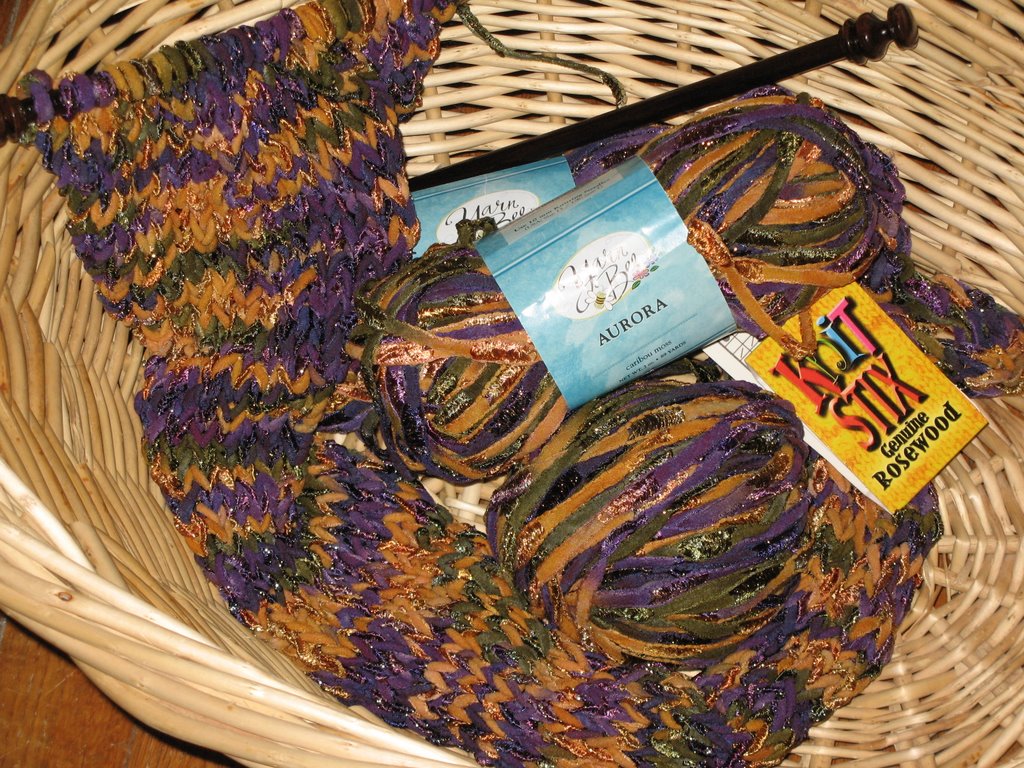
"I'm sorry, Father... I'll put the yarn away... And then there were these rosewood needles. So pretty .... I couldn't help that either. I am so ashamed to have so little control over myself."

"Oh, and a few more things ... I have used the Lord's name in vain a couple of times, but only when I was ripping back mohair lace ... and I was watching "Deadliest Catch" on TV last night, and I caught myself having impure thoughts regarding Captain Sig ... and there's been a bit of gluttony ... I got into the chocolate, and also the ice cream, but it was just one Klondike bar. Does that count?"

--Mambocat

Friday, July 14, 2006

Jury Duty

I tried to console myself. I really tried to think noble thoughts about my solemn duty as a citizen. I tried to think of Stephen Biko, beaten to death in a South African prison ... of women in the Middle East getting stoned to death for adultery, or beaten if they make accidental eye contact with a man to whom they are not related ... of the Disappeared in South America ... all people who dearly wish they lived in a nation where they could have some semblance of a fair trial.

But in reality, I was thinking of only three things:

1. How far behind I would get with work...

2. Being subjected to profoundly bad coffee** and being crammed into a room with 152 people and 96 hard plastic chairs...

3. Thoughts of hours of uninterrupted knitting prior to being called into the courtroom for voir dire.

**(The three worst places to find coffee in the United States are: the Nashville airport, the Texaco station in Snow, Oklahoma and the 19th Judicial District Court in Baton Rouge)

So, I brought my summons, parked in the big concrete garage, and presented myself for duty. There was a slightly befuddled young sheriff's deputy who had never seen knitting before, but no problem with the plastic needles at security. I even brought my own coffee. I was pleasantly surprised to find that, instead of contending for orange plastic chairs in the Hideous 1970s Waiting Room From Hell, jurors can now wait to be called in the public library immediately adjacent to the courthouse, a much more pleasant prospect than my previous experiences with the jury pool. Life looked good.

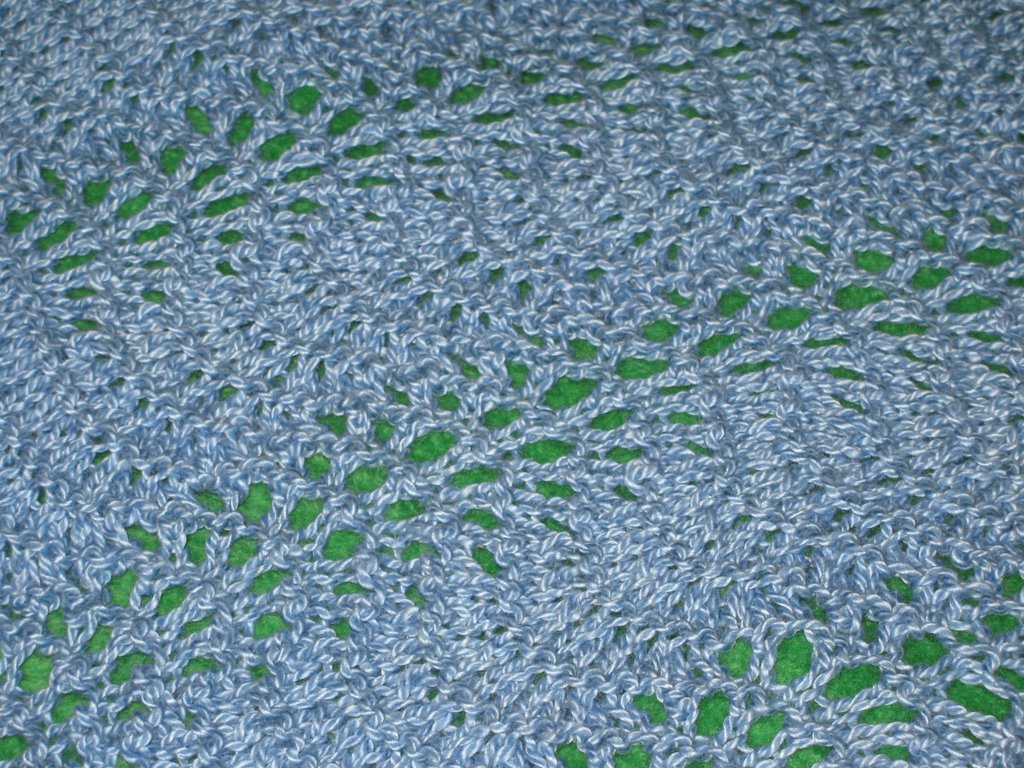
But, after three whole days of knitting in the jury pool, and not getting called, all I accomplished was about three square feet of a simple Old Shale stole. Here's a peek at the unblocked fabric:


Yarn consumed: about four skiens of vintage Unger Plantation Cotton generously given to me by Diann Lippman. When she gave me this yarn, she of course did not know that I made a "hippie shawl" out of Plantation Cotton many aeons ago in a very similar color, so this is a fun deja shawl experience for me. Thanks, Diann!

Working with cotton sometimes makes my hands ache, so I also cast on for a pair of socks.

This round of jury duty has taught me not to bring an interesting-looking knitted object into a situation with a high density of non-knitters who haven't brought anything to read or otherwise occupy themselves and who, desperate for conversation, want to regale you with all kinds of questions about why you would knit something you could buy at WalMart.

Best of all, they think they are clever, and that they are the first person ever to confront you with the fact (get ready for a shock) that ready-made socks and sweaters are commonly available in retail stores.

(((***... IF ONLY I'D KNOWN ... ***)))

This I promise to myself -- next time I have jury duty, I won't shower or comb my hair, and I will wear my ratty old Aqualung raincoat, and bring socks to mend. Smelly ones, even. That'll keep 'em at arm's length. That will be way too weird to even ask about. In fact, it might even get me out of jury duty for good..

On the bright side, I found myself filling the role of "yarn magnet" quite nicely. As I sat in the library waiting for my name to be called by Der Jurymeister, I soon found myself accompanied by a crocheter, who asked "may I sit with you? It's great to sit with someone else doing needlework." She was soon followed by a seasoned knitter working on a cabled scarf and then by a brand-new collegiate knitter who was floundering in deep water because her mother's friend had decided to teach her how to knit socks on two circular needles as her very first project (at least she had a copy of Cat Bordhi's book).

This made for a total of four public knitters out of a group of about 200 potential jurors. This means that two percent of the pool was emotionally comfortable enough to do needlework in public. A few other people admitted that they wished they had brought their needlework, and there were probably a few more silent knitters out there in the pool, wishing they had brought their WIP, but who had left it at home, perhaps out of fear of having their work snatched away by a sheriff's deputy.

Here is what I learned from the non-needlework, non-book-reading jury pool members:

I was reminded -- as I often am -- that non-knitters rarely consider bringing along something to occupy their hands and minds on those occasions when they are certain to spend a good deal of time waiting for their name to be called.

I was reminded -- as I often am -- that the vast majority of such people will make every effort to quantify the degree of the boredom they are enduring, and to relay this infomation to the person seated closest to them.

I was reminded -- as, once more, I often am -- that the real Alphas of this group, the most vociferous of the Truly Bored, are unable to comprehend that, in these situations, one is powerless to do anything except wait. It is entirely out of our hands. We no more know when our name will be called at the dentist, the gastroenterologist or at jury duty, than we know when our name will be called when the Great Night Clerk In The Sky decides that it's check-out time for us at Hotel Earth.

Your name being called is a matter of Fate. This is a cosmic thing. A Zen thing. And it requires calm, focused meditation and simple acceptance.

Om.

So, I have concluded the following....

If you know you're going to be cooling your heels all day and you don't bring a book, magazine or even the morning paper to read, you don't have enough sense to be on a jury.

If, after being told by the Official Juror Wrangler, that you are allowed to wait in the library across the plaza from the courthouse for your group to be called, and you go hang around in the library but still don't even pick up a book, you don't have enough sense to be on a jury.

If you get upset because you didn't bring anything to do, refuse to pick up a book, and spend the entire day pacing back and forth along the plaza, smoking and cussing about how hot it is and how bored you are, you don't belong on a jury.

If you ask for, but cannot comprehend, a slow, simple explanation of the difference between knitting and crochet -- just the basic principle that one involves a single hook and results in a firm fabric, while the other involves a minimum of two needles and results in an elastic fabric -- then you most certainly will not understand mitochondrial DNA in a murder case, and therefore have no business on a jury.

If, after denying yourself books and ruining all attempts at small talk with your fellow jurors, you continue to talk at people who clearly would prefer to discuss something besides the magnitude of your boredom, you don't belong on a jury.

In short, if I were the defendant, I would rather haul in three winos from the alley behind the courthouse and allow them to decide my fate over a game of Rock, Paper, Scissors than have you on a jury.

On the bright side, if you are such a person, you are almost certainly not reading this blog.

Or any other knitting blog.

Or any book reviews, either.

--Mambocat

Tuesday, July 04, 2006

DONT TREAD ON ME

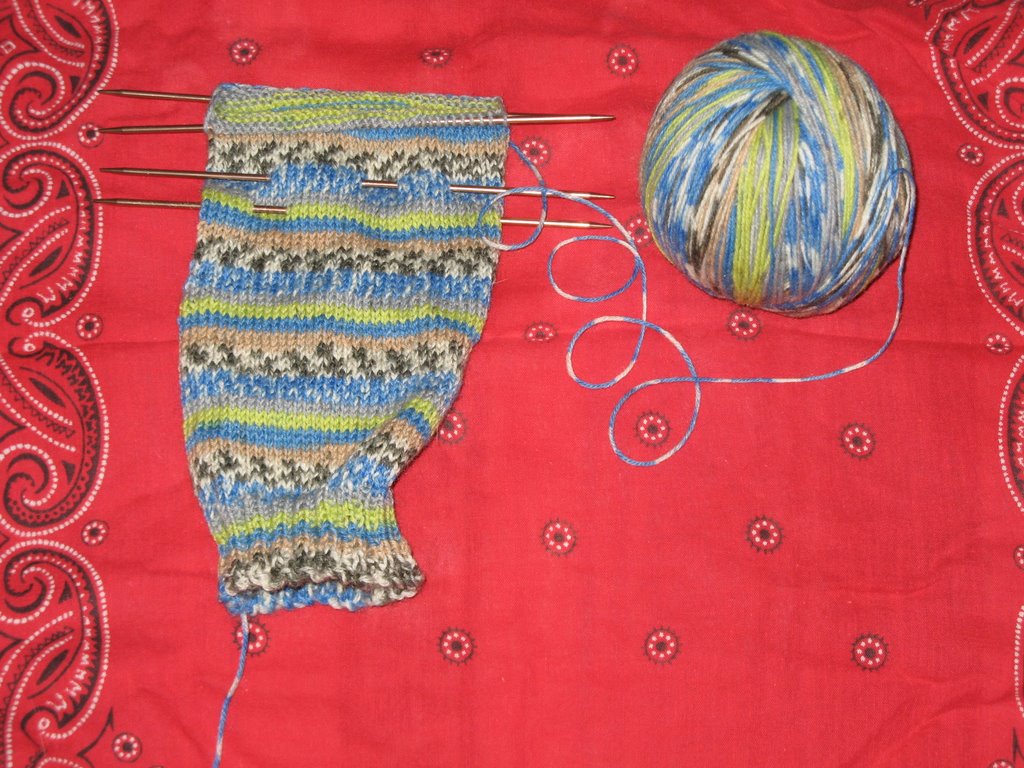
In honor of the Fourth of July, I am knitting a sock on a set of four needles, American style:


This is how I learned to knit socks, and even though I sometimes knit with sets of five DPNs, and know how to knit socks on two circulars and even one, this is the method I always return to. I like it. Partly because I am a purist and like to do old-fashioned things the old-fashioned way, and partly because this is just my automatic, default mode of knitting socks.

Have you ever taken a moment to consider how critical a pair of socks might have been during the Revolutionary War? As non-knitters often remind us (just in case we hadn't noticed that giant Wal-Mart where a neighborhood park and school used to be), we can buy socks anywhere today, for next to nothing.

But this was not the case during the Revolutionary War. If you dig around inside your brain and dust off the box labeled "American History," you will find a certain scrap of information handed out to every schoolkid, the bit about how cold it was during the Revolutionary War, and how many soldiers suffered from lack of proper shoes and warm stockings, often resorting to wrapping rags around their bloodied feet in order to keep pressing on against the British.

One Mary Frazier of Pennsylvania made a personal mission out of providing warm clothing and hand-knit stockings for the troops at Valley Forge, frequently loading her horse's saddlebags with needed items. She would find her way to the various camps by following the marks of bloody footprints in the snow.

Imagine. For the simple want of socks and shoes. So can you imagine how critical knitting was at the time?

I have a guess as to why Americans usually knit on sets of four double-pointed needles, instead of five. And I imagine it started during Colonial times, when needles, like shoes and readymade stockings, were in short supply, due to various shortages and boycotts against British goods.

I like to imagine a group of say, two dozen or so Colonial women, gathered in some farmhouse one cold winter afternoon, cranking out socks in a hurry for Washington's troops. Everyone in the village who owns a set of sock needles has gathered together in this place to share the work, enjoy each other's company, and perhaps hear a bit of news about the war.

Those without needles help by winding yarn into balls, carding fleece, and spinning. Needles click and the knitters discuss which one is having a troublesome pregnancy and which one is casting her eyes at that handsome young farmer down the road. One complains that her hens won't lay. Another makes a pot of hot cider.

Suddenly, one of the knitters recalls how she once "made do" when she had temporarily misplaced one of her sock needles. She had rearranged the stitches and worked on four needles. That stocking had turned out just fine.

She pauses for a moment, and looks about the room, regarding each of the knitters busily wielding a set of five needles. She does a little calculation in her head and she proclaims, "there are twenty knitters in this room. If each of us knits with only four needles instead of five, we shall have twenty spare needles -- five more sets of needles with which to make stockings. Let me show you how it's done..."

Everyone considers this for a minute. One by one, they begin to rearrange the stitches on their needles, fiddle a bit with their arithmetic, and employ some bright thread scraps for stitch markers.

Someone gathers up the surplus needles, and sets of four are handed out around the room.

Soon there are twenty-five people knitting. By the end of the evening, there will be twenty-five more socks for Washington's troops, five more than would have been possible when the sun came up that morning.

One of the women at this gathering happens to operate a drygoods store along with her husband. She returns to the shop the next day, divides her needles into sets of four, and sells the sets for a slightly smaller price than the drygoods shop down the street, giving herself a competitive edge.

Word spreads. It becomes a local habit, this business of knitting with only four needles. Needle merchants pick up this bit of marketing savvy and pass it on to other colonial towns, where it catches on.

And so, to this day, most Americans knit socks with four needles.

Hey, it could have happened that way. I like to think that it did. I like to think that necessity encouraged some bright woman long ago to "unvent" something truly ingenious, at a time when something as simple as a pair of wool socks may well have saved the day to keep a Revolutionary soldier warm, functioning and focused on the enemy instead of his frostbitten toes.

One woman's quick thinking may very well have provided 20% more socks to the Revolutionary Army. For all I know, more warm feet may have helped turn the tide of the war.

While that story is pure speculation, the following story is true.

There was a Pennsylvania woman named "Old Mom Rinker" whose village inn was invaded by the British, and whose family had the detestable duty of pouring ale and serving stew to the Redcoats. Because Old Mom Rinker was "only a woman," and a humble innkeeper at that, the British officers arrogantly assumed her to be stupid, unable to comprehend military strategy, and unworthy of consideration.

So each night, as her family waited on the Brits, they kept the ale flowing and kept their ears open. Rinker devised her own way to convey what they learned about British troop movements to the Revolutionary army.


Each morning, after breakfast was served, she would carry her kntting basket to a steep bluff overlooking the road, and would sit on a rock at the edge of the bluff and knit. Imagine how quaint she appeared ... how invisible she would have been to the British officers ... an old woman, sitting on a rock and knitting in the morning sun.

What the British officers did not know was that Old Mom Rinker had written down everything she heard them say on a slip of paper. And she had folded that paper around a small stone, and used this little package as the core around which she wound her ball of yarn.

They also did not know that she watched for a rider on the road below, and that when he appeared, she would oh-so-casually nudge the ball of yarn over the edge of the bluff, and let the ball drop down, unwinding as it went, to finally run out of yarn. The weight of the stone then carried the note to the ground, where it was secured by the rider, who would trot off into the forest with critical news for General Washington.


Then, ever so casually, she would wind the yarn up again, and go on her way.

Who knows how important those messages were to the outcome of the Revolutionary War?

Every year, on the Fourth of July, I contemplate what I like and dislike about the America of today. I wonder what the founders of our nation would think about the way the nation they midwifed into existence has grown up.

I also wonder how many other Americans stop for a moment on the Fourth of July, not to be jingoistic about the America of the present, but rather to reflect on the America of the past, and to ask ourselves if we are living up to the challenge set out for us 230 years ago.

I like to think about where we came from. Whether or not the founders of this nation might have reconsidered a few things if they could see us today ... whether they would have handled some things differently ... what they would think of our mistakes ... and how pleased they would be on the things we've done well.

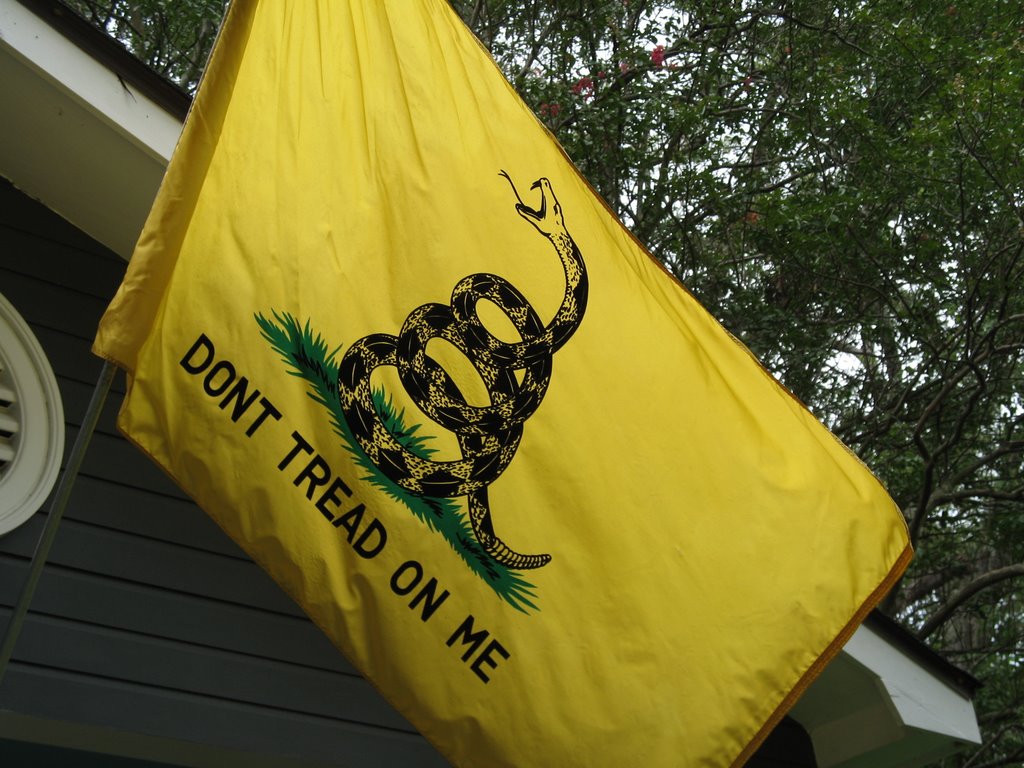
I like to fly our own American Flag all year long, but I especially enjoy it on the Fourth of July:


I can see you scratching your head with that size four DPN.

You're saying, "wait a minute, that's not an American Flag. That's a yellow flag with a snake on it."

You are quite correct in the latter observation. It is indeed a flag with a snake on it.

It is also the very first American flag. It is called the Gadsden Flag, named so for Colonel Christopher Gadsden who led the Sons of Liberty in South Carolina beginning in 1765 and who later served in in the Continental Army. In 1775, he represented South Carolina in the Continental Congress.

Like American Indian tribes who revered Rattlesnake for her vigilance, for standing her ground, and for her ability to reserve her venom until needed, Benjamin Franklin was duly impressed with the rattlesnake and considered the animal as a mascot for the new nation:

"She never begins an attack, nor, when once engaged, ever surrenders. She is therefore an emblem of magnanimity and true courage. She never wounds until she has generously given notice, even to her enemy, and cautioned him against the danger of treading on her."

Colonial folk held the superstitious belief that snakes, having been chopped up, could somehow re-assemble themselves and crawl away. Biologically impossible as this may be, the superstition had fantastic value as a cultural icon. In 1754, Ben Franklin designed, carved and published a woodcut of a rattlesnake cut up into thirteen sections, each section labeled with the name of a colony. The picture was entitled, "Join or Die." It was the first political cartoon published in an American newspaper.

The rattlesnake symbol became immensely popular amongst the Revolutionaries. The image was picked up by Gadsden, who placed his version of it on the flag of the Sons of LIberty. This flag (the flag on our house) depicts a intact rattlesnake, coiled in a state of vigilance, captioned with the warning: DONT TREAD ON ME.

The Virginia Minutemen added the phrase, LIBERTY OR DEATH to their version of the Gadsden flag.

A modified version of DONT TREAD ON ME depicts a rattlesnake crawling diagonally across a field of thirteen red and white stripes.

Starting to sound familiar?

This last was the first flag ever flown on an American military ship. To this day it is called the Navy Jack.

The lack of an apostrophe in the "DONT" is not an accident. Standards for abbreviation were inconsistent at the time.

We fly this flag at our house to remember that the nation founded 230 years ago was a nation founded by dissidents, by people who were unhappy with the status quo. It was not founded by British Loyalists.


It was founded as a living nation, with a living Constitution. Living things grow and change. This nation was founded by men considered to be enlightened by many people of their time, and traitorous by others. They drafted and signed a Constitution knowing full well that they might be hung for treason. They also had their flaws -- they created a nation with "liberty for all," yet owned slaves and scoffed at the notion of women voting and participating in politics.

And these flawed, yet forward-thinking people did something remarkable: they created a brand-new nation with the intent that this nation could, and would change. With the intent that those who disagree with it should -- make that must -- unite and change things when this nation goes wrong. Not only is it not unpatriotic for an American citizen to voice diagreement with government -- it is our solemn duty to do so. It is the very reason this nation was created, so that a static and tyrannical government would not maintain power over the people.

I doubt very, very much that Thomas Jefferson or Benjamin Franklin would have taken to the notion, "My country, right or wrong."

They would have wanted it to be right. And, if it wasn't, they would have changed it.

When you think about it, it's a lot like knitting. You make something. If it doesn't fit, or it didn't work out the way you planned it, you have a choice: you can go ahead and wear it anyway, and endure the imperfection. I am sure there are knitters out there who proclaim, "my sweater, mistakes and all" -- and you have the right to do that -- or, you can rip it out and start over.


Either way, you have every right to take pride in being a knitter.

--Mambocat


Saturday, July 01, 2006

Happy Canada Day!

In my ongoing efforts to enlighten and educate, I thought I would mention that today is Canada's birthday.

I like a lot of things about Canada.

First, Canada has produced all kinds of knitting prodigies, most lately, Stephanie Pearl-McPhee. Not to mention yarns from Paton's, Bernat, Spinrite, and ... drool drool drool ... Koigu.

Canada makes great beer, too.

Canada has the Canadian Rockies and the Boundary Waters and Niagra Falls. Okay, we share the last two, but still.

Canada has Mounties. Yes, I know the uniform is only a dress uniform, but don't ruin this for me, okay? If we had anything like Mounties in America, a speeding ticket would hurt a lot less. If they wore the uniforms.

Canadians don't assume that the rest of the world considers Canada to be the center of the Universe.

Canada has given the world many wonderful musicians ... Joni Mitchell, Neil Young, Leonard Cohen, k.d. lang and many others, as well as the Montreal Jazz Fest.

And speaking of music ... a patriotic Candian with a normal, untrained voice can actually sing "O, Canada."

Excellent knitterly weather: Sweater weather for the majority of the year, real seasons, and very rare hurricanes.

Canadians, although sometimes armed, seem to understand that it's not really necessary to shoot each other on a regular basis.

Canada gave us Newfoundlands and Labrador Retrievers. Even some obscure breeds. How cool is that?

Peter Jennings.

Canada is a peaceful nation.

Canadians get health care for everyone and dignity for gay folk. I am assuming dignity for everyone else as well.

Barenaked Ladies.

A seriously groovy flag.

Canadians tend to think of a second language as a benefit rather than a threat to national security.

Canada has given Americans refuge in times of conflict, whether Americans were in need of a place to get away from Vietnam or in need of being smuggled out of Iran in 1979.

Canadians say, "eh" just like Cajuns.

And of course, Canada gave us Cajuns. If Canada hadn't exiled them, Louisiana would just seem like more of Texas.

Okay, I admit, Canada has Celine Dion, but can't we forgive this? Can Americans really pick on Canada for Celine Dion when we gave the world Britney Spears? I mean, you can take the girl out of Tangipahoa Parish, but you can't take ...

ahem. I digress.

Happy Birthday, Canada. Live long and prosper.

--Mambocat

Tuesday, June 27, 2006

Area 51

The other day I thought I was just another normal Knitter.

You know -- closet full of yarn. A number of airtight plastic tubs full of yarn tucked under the bed and stacked in corners. A handful (okay, King Kong's hand) of harmless-looking tote bags of various sizes tucked discreetly into corners, inside the TV cabinet, in the storage closet, and under the futon.


In the car, a couple of projects in case I get stuck waiting somewhere a really, really long time.

Socks in my daily tote bag for the same reason. And then there's always a pet cozy on the needles in my desk drawer at work -- just in case I get a lunch break -- and a couple of 5-gallon plastic kitty litter buckets full of small projects at Mom's house. Only two. Honest. Gotta have something to keep my hands busy when I visit.

In my sock drawer here at home, you'll find a few random skeins of sock yarn to inspire me.

Oh, and two projects in that clever storage ottoman in the living room. I like that ottoman. It is a plain, beige ottoman. It looks like something you just put your feet on. Who would think it has yarn in it? It's like having stealth stash.


You know. Just the usual.

So I tried to do a little Spring Stash Organizing.

MISTAKE.

I now realize that either I am in a Stephen Spielberg movie, or I have been transported to Area 51, because there are more UFOs flying around this house than I ever thought possible.


Recent UFOs:

Two projects, gifts, and so nearly done that they are almost ... and I mean they are THISCLOSE to being ... FOs.


Here, look at this kid's poncho. We're talking ten ends to tuck in, then the Fringe Fairy needs to get off her tookas, and then a little blocking:


Okay, a lot of blocking. And ...

There is also a lace baby blanket, in cotton, needle size US6, for the first-born of our nephew and his wife. However ... praise the ancient gods of Scotland ... this baby-to-be is a Crawford. I can have absolute confidence in the fact that the wee wane will be late.

Quite late.

Also, for Crawford reasons, it's being done in a soft, natural, cotton which can be yarked upon by baby, merrily slobbered on by happy dogs, and washed with complete disregard for fiber-mercy of any kind.

And all I have to do is block it.

Other recent UFOs:

Koigu KPPPM merino sweater for me, in yarn from Stitches West 2006. Yum.

Koigu lace merino shawl for me, also from Stitches.

Saints socks. New Orleans Saints team color socks. Exactly 1.75 New Orleans Saints socks, to be exact. The Saints Socks were to be among Dad's 2005 Xmas gifts, but Dad passed away and then Katrina hit. I have not been able to deal with these socks yet.

Inca Alpaca gansey for me in an amazing shade of cat-eye green. Yum again. Needles: US5.

Another funfunfun kid's poncho for a dear friends' daughter. Can't show it because it is a surprise. This was also supposed to be for Xmas 2005, but Katrina derailed me. This one is crayon-box stripes in Unger sportweight Utopia done serape-style for an 8-year-old. One skein, assembly and finishing left on that one. This, along with the red poncho shown above, resides in the ottoman in the living room. Shiny, happy, mindless TV knitting.

One gauntlet, in my own handspun, on size three needles.

Matching hat, half done, in my own bulky handspun, size nine needles.

Sweater for Dave, also pre-Katrina, just a casual pullover sweater from washable wool-blend oddballs. Size 7 needles.

Newly cast-on sweater for Dave, in luscious, soft, sweet-smelling Forever Random from La Lana Wools, purchased at Stitches West. Dave met Luisa and picked out his own sweater yarn, so this will be a significant sweater.

Einstein for Mom, for this Xmas. Four inches of an Einstein, anyway. This is being done in a rosy-tweed bulky yarn, a washable acrylic/wool blend, from Michael's craft store's "Passport" yarns.


Middle-aged UFOs:

Socks:

1.5 socks in Opal variegated ocean blues and greens, size two needles.

Half a sock in Lion Magic Stripes, shades of blue, size three needles

Quite nearly two green socks in a vintage Fortissima ragg yarn, size two needles

Almost one whole sock in Opal Bumblebee, size two needles

One sock cuff in my own handspun from a very nice sheep named Sabrina.


Non-socks:

Two hats in my handspun, on size 4 and 6 needles.

1.25 slippers in Lopi, to be felted, on size 11 needles (car project)

One third of a stole in various glam yarns in shades of blue, green, and purple on size 10 needles.

Half a French-style string net shopping bag, in crochet cotton, color natural (also a car project).


Vintage UFOs:

I have been knitting for 40 years.

OK, I admit that Grandma started teaching me when I was in kindergarten. But still and all ... I have been knitting for so long that I don't just have vintage clothes, I have vintage projects, incomplete garments which will become instantly vintage the very moment they are new.

Torso (sewn together, even) of tailored jacket, to be part of skirted suit, knitted in perle crochet cotton on size three needles. Vintage: 1989. The problem is not the needle size. I like size three needles. I would much rather knit on needles in the size range of US one through five than any other size. But the whole thing is in heel stitch. In cotton. The resulting fabric has a terrific drape, resembles good corduroy, is lustrous, and weighs about as much as a deisel locomotive. It looks elegant, even. But heel stitch....miles and miles of heel stitch. In cotton. What was I thinking? If I can only get past the sleeves, I know I can summon the will to cast on for the skirt and just go round and round and round and round and round and round until I run out of yarn. But ... heel stitch ....? Round and round and round in heel stitch? In cotton? What was I thinking ... or drinking ... when I had this idea?


Was tequila involved in this decision?

Kimono sweater of my own design, in Rowan Donegal Brights sportweight wool, also on size 3 needles. Vintage: 1994. Yarn bought on clearance sale in mad, random colors. I was inspired by Kaffe Fasset at the time. Still am. But I am completing the long, skinny strips of this sampler sweater by doing some "challenging" stitch work like Barbara Walker's cable spider. At the geologic speed of completing one strip per year, I should finish it in 2013.

Beret in Lang Vera Stretch Wool (navy) on size 6 needles. Of course, this purchase of this yarn was a Magpie Moment, and I bought only one skein. Of course, I ran out of yarn 2/3 of the way through, with a hole the size of a yarmulke needed to complete the top of the beret. Of course, this yarn has been discontinued. What ungodly force made me think that one baseball-sized skein would make a beret? It's soooooooooo soft, I do want to finish it someday. Does anyone happen to have even a golf-ball sized oddball of this stuff laying around in Navy? Any dye lot will do. Otherwise, I am stuck with the choice of either ripping it out, or wearing a hat that resembles a fuzzy, dark - blue tire. Hmmmm .... maybe I should start a cult?

And these are just the UFOs I can find.

Help.

--Mambocat

Sunday, June 25, 2006

Bet You Thought I Forgot.

Back in April I had a mini-contest for the five strangest places you've ever knitted, with a deadline for submissions of May 12.


Prize for the strangest places was to be a skein of Gomer Pyle ("surprise, surprise, surprise") yarn.


But here it is, June 25. I didn't forget to announce the winner, of course. I just hadn't gotten around to organizing stash yet.

Fib-O-Meter Translation: Mambocat couldn't find the yarn

Everyone's submissions were good, so I drew a name at random.

Method: write each name on a slip of paper, fold it, drop all folded slips on floor, then pick up the first one batted in my direction by a cat.

The winner is: lornajay!


And, here is the yarn, being modeled by "Seven," who has found the absolutely comfortablest place on top of the pile of blankets on the futon:


Not one but two skeins (you really can't make anything with just one skein, now, can you?) of Passport Yarn "Dublin", a machine washable blend of 51% washable wool and 49% Courtelle acrylic. This yarn is a chunky weight with a very nice feel -- I'm using it to make an Einstein coat for Mom for this Christmas -- and I hope you enjoy it, Lornajay. Passport is made for Michael's craft stores in the United States and to my knowledge it has been discontinued.

To visit Lornajay's list (and everyone else's) of strangest places ever knitted in, please visit my April 27 post in the Archives.

On to other strange places.

I returned from my seminar in Gulfport., Mississippi, a little bit east of where Katrina made landfall. Ten months after Katrina, a large portion of the shore road, Highway 90, remains closed in the area of landfall, around Waveland and Bay St. Louis, Mississippi, near the Louisiana border.

Actually, closing the highway in that area was not really necessary.

The coastal highway is gone.

In eastern coastal Mississippi, where Highway 90 isn't gone ... just about everything else is.


Can you guess what the vertical white things are, in the midground of the next picture?

And what's that stuff in the grass, in the foreground?

To enlarge the picture, click on the picture, then click on the lower right-hand corner.

The white things are pilings (foundations) of several houses which sat high up off the ground in hopes of avoiding the storm surge. The houses are now gone. The trees you see are mostly very tall pines which have been stripped of most of their branches. The green, weedy places in the foreground are lots where other houses with concrete-slab foundations stood, less than a year ago.

And the stuff in the grass?

That's the beach. Katrina decided to move the beach a quarter-mile inland.

This was once a fairly dense coastal neighborhood, full of houses and businesses. And now?

Well. You can see.

This is where it's "not so bad" in Mississippi. Gulfport is pretty much gone within 1200 feet of the beach, and badly damaged inland, but non-beachfront Gulfport is still mostly recognizable as a town, and is trying to recover.

The entire town of Waveland -- back where the highway is gone -- has simply been scoured off the face of the earth.

--Mambocat

Wednesday, June 21, 2006

This Cannot Be Good.

Today is June 21st. I have in this very room, right here with me, a complete, ends-woven-in baby blanket. I brought the blankie with me to do the finishing touches and weaving in of ends so I would have something to do at the hotel where I am staying for a seminar. I wanted to post to my blog before I go home today.

The blankie needs only to be blocked, so please ignore the waviness and rumpliness: Also please ignore the hotel bedspread. I shouldn't complain, however. This hotel is in Gulfport, Mississippi, and was badly affected by Hurricane Katrina, and they are making do with oddments of furnishings as they repair the building and re-open one floor at a time.

I also brought along a copy of Yarn Harlot's latest book, Knitting Rules!, for bedtime reading. The only thing I had in my possession to make the blankie look cutesy and baby-ish was Meezer the Car Cat, who was a gift from my student worker a few years ago who noted that I had pets everywhere except in my car. Meezer usually rides around in the ashtray.


The blankie was knitted center-out as a part of a study of several garments using variations of the same lace pattern. I may just possibly include this in my pattern book.

Hopefully you are not snorting coffee out through your nose. Hopefully, you are saying something along the lines of, "hey, even in its unblocked state, that's a halfway-decent looking blankie that any self-respecting baby would be delighted to yark her peas and carrots on."

So why, you may ask, do I say that this cannot be good?

I will tell you:

I have a complete, full-size blankie on June 21st and my niece's baby is not due until September.

This can only mean one thing:

It's twins.

There is another baby in there that we don't know about.

I'd better tell the mother.

--Mambocat

Sunday, June 18, 2006

Supermodel Brawl

I ordinarily love using public statuary as garment models. Although it is often difficult to locate public sculptures of reasonably normal bodily proportions, it's always easy to find them again whenever I need them -- after all, it's not like they can run off to Italy with their boyfriends. Besides, they are quite good at standing still, I don't have to pay them anything (I don't even have to be nice to them), and the most temperamental thing I have to deal with on the average photo shoot is the weather.

But I suppose even bronze statues have their limits.

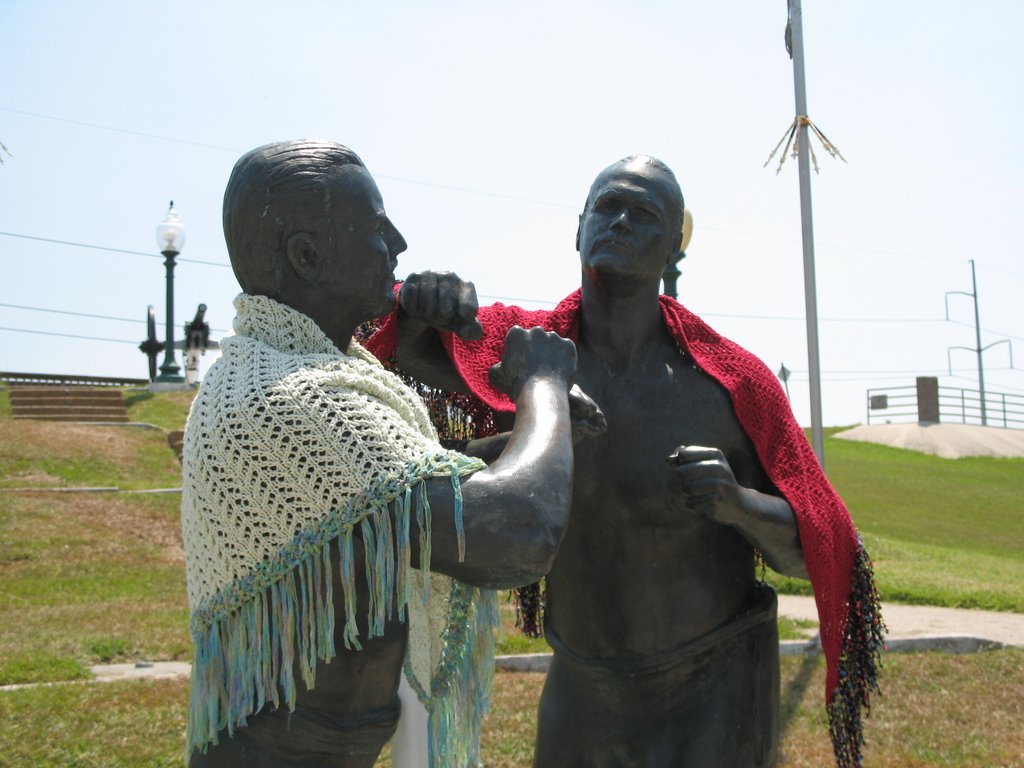
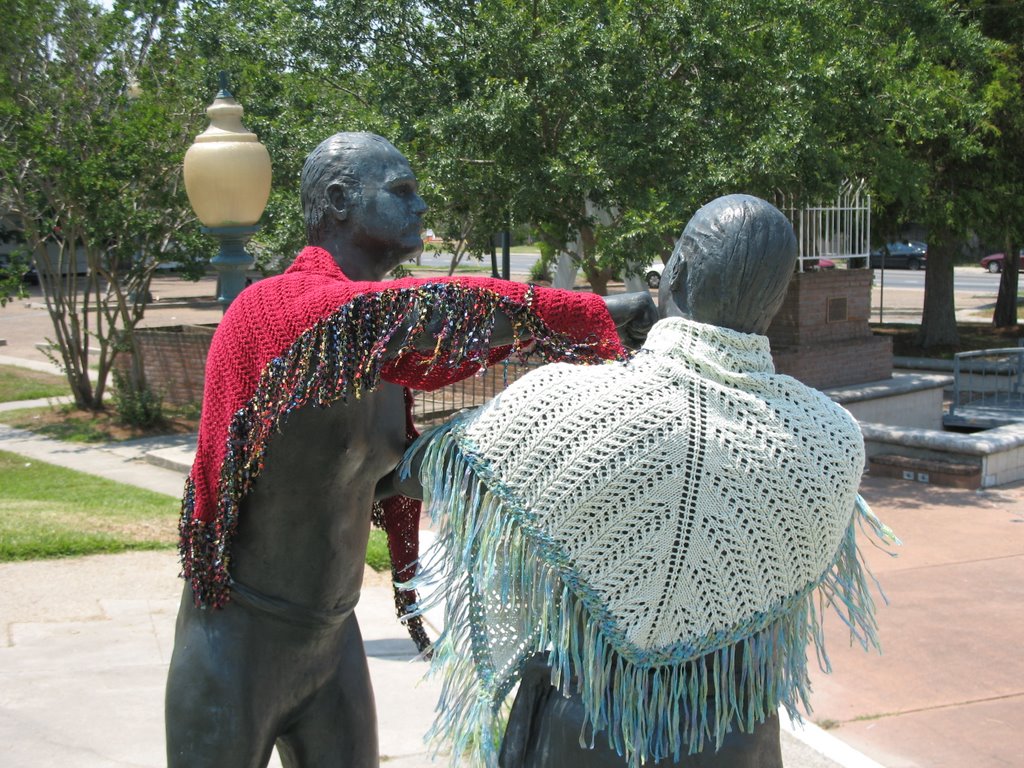
As soon as I draped these two models, who have worked for me for years, and who are usually quite cooperative with things like scarves and hats, all hell broke loose:


It started with a few testosterone-laden insults:

Model on left: "You like like a flamin' ninny in that shawl!"

Model on right: "Oh yeah? Well, you look like central casting for Queer Eye, and at least my shawl won't show your blood!"

KAPOW!!!!

And then it just went straight to fisticuffs, and there I was, darting around with my silly little camera, trying to stay out of the way, and wondering how I was going to explain all this to the perplexed people at the nearby bus stop, and possibly the police as well.

I decided just to let them duke it out ... get it out of their systems, ya know?

Besides, you just don't try to break up a brawl between a couple of enraged bronze statues if you have any sense about you.


The pale green one is the shawl I knitted during jury duty awhile back, a worsted weight five-skeiner done in GCH Samoa yarn, the GCH being for Garn GroBhandel-Hamburg GmbH, which is hopefully German for "cotton-wool blend made in Hamburg." I am worried, though, because something else on the label says, "Beanstandungen konnen nur bearbeitet werden, sofern alle Banderolen deises Garnen vorgelegt werden." I'm pretty confident this means either that the knitter can handwash the resulting garment, or that somebody is required to stand on a sack of beans in a dungeon near a bear who is beating up on a game warden, while the Rolling Stones douse someone named Garnen (probably the game warden) with vodka.

Anyway, regardless of the language barrier, this Samoa stuff is just as soft and cushy as a baby bunny's butt. It is a wonderful shade of the palest green, a green just barely past white, which the camera doesn't do justice to. The yarn was a gift from my dear friend Diann. She has a special word for this color, and describes it as the first hint of green in the heart of a white lily where the green ends down there deep inside the trumpet of the flower, and the white begins.

I was very happy with the shawl when it was finished, but it is such a pale green, so subtle, that I thought it required a border, something ribbony and pale, something to embellish the shawl and give it some movement, but without overpowering it. Being worsted weight, it also was asking me for a border to help lighten it up a little around the edges.

It is embellished with Trendsetter Pepita ribbon yarn. Pepita is an 86% polyamid, 14% polyester yarn. It is delightful and fun and translucent and weightless and slightly sparkly. It is expensive -- 14 US dollars a skein -- but one skein was enough to embellish a border and add some fringe on the pale, cotton-wool Samoa that needed to lose just a bit of its meekness so that it can be a terrific gift for a dear friend.

This is one of those great situations where a single skein of glitzy stuff is the perfect touch for fringe or a border, without hemorrhaging your piggy bank.

Knitting with Pepita is like knitting with fairy wings. It's a treat. Knit it on slightly blunt-tipped needles, though, if you try it. I started on narrow-point nylons -- my favorite for lace -- but they kept piercing the yarn, so I switched to my Pony Pearls which were perfect for this delicate, soft ribbon yarn.

I would love to make an entire shawl out of Pepita. I would also like to have a suitable place to wear an entire shawl made out of it, like on the beach at sunset somewhere in Hawaii, with the wind blowing, so all the delicate hints of sparkly stuff and all the subtle and translucent ocean hues could light up in the sunshine and all the ribbony fringe could dance in the breeze...

***
Oh, yes ... where was I?

And here's a rear view of the red shawl:


The blood-red shawl is also a gift for a friend. Yes, you are quite right -- it is the same stitch pattern as the pale green one done in Samoa. I used the same yarn for both versions of a shawl pattern I am working up for the book I am working on.

I wish I could tell you more about the cotton yarn. I wish I could tell you anything about the cotton yarn. It is a nameless sport-weight 2-ply perle cotton I bought on closeout at a New Orleans LYS (the Persian Cat) a number of years ago, and the fringe is a rainbow-colored ladder yarn of synthetic fibers.

Unfortunately, the fringe yarn is also anonymous, having been donated to me by a friend who had lost both the label and her patience, having thrown up her hands regarding the act of untangling it.

Oh, and one more thing...

Happy 64th birthday, Paul McCartney...


...yes, we still need you.

--Mambocat

Sunday, June 11, 2006

It's More Than A Ceiling ....


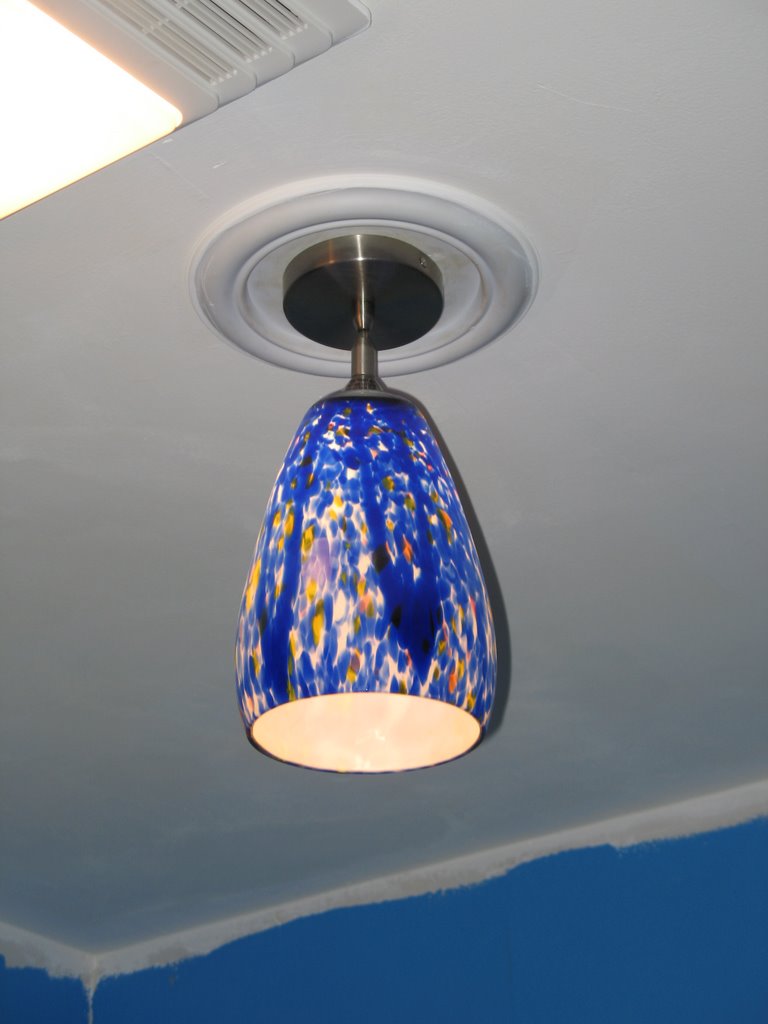
It is a ceiling with the lights turned on.

If you live in, say, Los Angeles or Denver or Cleveland Heights, having a light that actually turns on so you can see what you are painting in the bathroom is rather unremarkable, assuming you have paid your utility bill.

However, in New Orleans, nine months after Katrina, finally having electricity at your Mom's house is something to celebrate.

To celebrate this event, the functioning light fixture gets a post of its very own. The light fixture wants you to know that it is delighted to finally be able to do its job -- and, being a new light fixture, it wants to prove itself worthy. It's helping me see what I'm doing in the bathroom, which will come in handy when I get out the fine brush to fill in the blue paint up to the ceiling, to fill in that gap you see there and have a nice, crisp edge.

Light. How wonderful. There has been no light for so long we have to remember to flip switches instead of reaching for a flashlight.

Wherever you are, go in your bathroom, turn on the light, rejoice and do a happy dance. Not for me, not for Mom, but for the fact that you have lights in your house anytime you want them.

There are still a couple of hundred thousand folks in New Orleans and on the Gulf Coast who don't.


--Mambocat

Thursday, June 01, 2006

The Fifth Season

Today, June First, marks the official beginning of Hurricane Season
for the year 2006.

Where was I, one year ago today?

One year ago, I was getting ready for an animal sheltering conference in Arizona, and looking forward to my husband, Dave, tagging along with me on a "working vacation."

One year ago, I was worried about my 87-year-old Dad getting a new pacemaker and wondering how to celebrate Father's Day.

One year ago, I had a nice, steady job that I liked a great deal, managing a large public animal shelter.

One year ago, I didn't cry easily.

One year ago, at the beginning of Hurricane Season 2005, the photos on my digital camera consisted predominantly of family, friends, pets and knitting projects.

One year ago today, a benign and amorphous thing that would later grow monstrous and take the name Katrina, was just a little warm spot on the ocean someplace off the coast of Africa. Her sister, Rita, was also in an embryonic and sun-kissed state of being. No one but sharks could tell if there was any significance whatsoever to those two warm spots in the sun-drenched tropical sea.

But today is the first day of Hurricane Season, 2006.

Today, I have no conference to attend.

Dad is gone, so I have no plans for Father's Day. This hurts hugely, so much more deeply than I can possibly begin to describe. There is a bag of cocoa-colored wool in the bedroom closet. It was supposed to be Dad's Christmas sweater for 2005.

It remains un-knitted. It is still just yarn.

Today, I am unanchored in the animal sheltering community, at least for the moment.

Today, while I still have photos of pets and knitting and family on my digital camera, I mostly have pictures of shattered houses, dead animals, and devastation so vast and raw with pain that I almost feel foolish trying to convey its enormity and ongoing urgency on this little bitty knitting blog floating around out there in the ether, amidst a million other public diaries.

Today, I cry at the drop of a hat. This is new for me. I used to cry only when someone extremely dear to me died -- a family member, a pet, or a human friend. In extremely rare instances, I would squeeze out a tear or two during the last scene of Casablanca, or if I heard "Teach Your Children" on the radio. When I wept openly at the end of Philadelphia Story, I was astounded. So was my husband.

I was a tough kid. I wasn't one to cry. Ever. Sissies cried. I didn't cry when I skinned my knees, needed stitches, fell out of a treehouse or had to go to the doctor for vaccinations. I hid in the doctor's closet or under the exam table, but I didn't cry.

I wasn't afraid of the dark. I wasn't scared of snakes and lizards and spiders -- in fact, I liked them, and still do.

I wasnt afraid of storms, and I didn't believe in monsters. Halloween was my favorite holiday. I thought it was great fun to terrify other kids with elaborate ghost stories.

I would always be the one to do scary things on a dare.

Climb on the roof. Look over the edge. I dare you.

Climb way up on the second floor roof of your friend's house and stand there, teetering over the edge. I could do that.

As I got older, I was the one who friends came to lean on -- Dez is tough. Dez will know what to do.

I kept myself glued together when one of my dearest friends was murdered for her purse, when beloved ones died from AIDs, commited suicide, succumbed to breast cancer, or died from heart attacks at ridiculously early ages. I kept plugging along through my husband's strokes and, two weeks before Katrina hit, I got through my Dad's eulogy with a strong, clear voice.

I thought I had grown into a tough adult.

Life in general, years of work in animal rescue and the tough reality of animal sheltering work made me think I thought I could deal with anything.

But now I start into the boo-hoos when I hear Dr. John sing "Such A Night" on a New Orleans radio station. I cry sometimes when I drive through Audubon Park in the early morning, or when I see a row of ancient shotgun houses in the light of the setting sun. I weep when I see an elderly black lady planting bright, springtime flowers in the tiny front yard of her storm-battered home.

And tears run down my face uncontrollably when I hear Randy Newman sing to remind us that "they're trying to wash us away... they're trying to wash us away... Louisiana..."

No one particular thing caused this change. But many, many things combined to fracture my foundations -- the pitiful rasping sound made by starved and dehydrated dogs and cats who had barked and meowed themselves voiceless in their desperate appeals for salvation ... the shattered houses of the Ninth Ward, New Orleans East, Gentilly and Lakeview ... the bloated carcasses of horses caught in the few massive oaks left standing in Plaquemines Parish ... the unforgettable stench of New Orleans in the first weeks after Katrina .... a human skeleton lying in the narrow side yard of a Ninth Ward home ... the spray-painted and multicolored messages and X's on half a million front doors which announce the safety status of each home and the presence or absence of human or animal remains within ... the overturned public transit busses ... and the devastated faces of the brave New Orleanians I met in those first days, people who arrived at the massive emergency public animal shelters in Baton Rouge and Gonzales with nothing but the reeking clothes on their backs and a terrified and filthy dog or cat desperately clutched in their arms.

No human or animal should ever have to experience such horror as they did.

For months, my job kept me going, and did not allow me to feel very much. There was too much urgency, too many in need of help from us, the Helpers. So much for us, the Helpers, to do.

So much to do. So much comforting of others in much greater need than ourselves. No time to experience our own grief.

And now the urgency of rescue has passed. There is work to be done ... much work ... work for decades... but no desperate work related to the immediate matter of rescue from death in the aftermath of the storm.

At least, not today.

Not again, not yet.

Not on this brilliant first day of June.

I do not know what this summer will bring.

I hope it brings nothing newsworthy or noteworthy at all. I want us all to be bored this summer. Very, very bored.

But in the meanwhile, I cannot stop. I cannot stop talking about it, writing about it, waking up in the middle of the night about it.

And now I am knitting about it. Knitting about it, and writing about it, and writing about how knitting has gotten me through this so far and may continue to get myself and others through this.

What I really never thought was that something as simple as a blog, an online diary -- just a place to blab, when you think about it -- could be so helpful. So cathartic.

Thank you all for reading my blog.

--Mambocat

Saturday, May 27, 2006

Mambocat's Midlife Mojo Mission

Bonjour, mon chers. I have been run hard and put up wet for waaaay to long and I am starting a much-deserved vacation.

No photos today. I have a few announcements to make.

I am having a midlife crisis of sorts.

This does not mean that I am going to get a tattoo, buy a red convertible, start wearing black lipstick and hang around with cute boys who aren't quite old enough to buy beer. But it does mean that I am experiencing a powerful, screaming urge for creative outlet in the forms of writing and visual art.

It also means that post-Katrina circumstances have brought uncertainty into my career, and I need a break so bad that I am either about to explode, fall flat on my face or go check myself in at the Ha-Ha Hilton.

This is how a friend of mine pointed it out to me: "Let's see, Dez. What happened in the past nine months for you? Major crises and minor crises. As I recall, you hadn't had a real vacation in over 5 years to begin with, and you were just thinking about taking one when Katrina hit. So. Hmmm...your Dad died, you had surgery for a major staph infection, Hurricane Katrina hit, you worked at least 80 hours a week during the animal rescues and in the emergency shelters through the end of the year, you had your Mom living with you since Katrina, you had other people living with you till they could go back home, you sprained your good knee in the middle of all of this, you changed jobs, you have been commuting to New Orleans, repairing your Mom's house, fostering cats, dealing with all the hassle of all your Dad's vital records and death certificates being lost in Katrina, and what else? Fighting with insurance companies, utility companies over your Mom's house, and your husband having surgery again, and hassles with his health insurance ... and what? ... you got maybe 17 hours of sleep, total, since Katrina hit? Honey, you need a break."

She, being an old soul, a wise human, a rescuer of dogs, and a good friend, is, of course, absolutely right. She also left out a lot of lesser bad things which have happened, but I didn't tell her that.

Has anyone seen my mojo? She is about five-foot-seven, has long black hair, and is usually seen wearing a batik skirt and cowgirl boots, and a sweater or shawl, depending on the weather. She has a bottleof wine in her backpack and the Grateful Dead, Bob Dylan and Mississippi John Hurt in her tape player. There's always some knitting in her bag, and a couple of dogs and cats following her around everywhere she goes. She laughs too loud, wears turquoise Indian jewelry, and dances to zydeco music. I used to see her all the time, but in recent years I have seen her much less often. The last time I saw her was sometime a few Octobers ago, I think. She slipped around a corner in New Orleans on her way to Tipitina's and I haven't seen her since.

I need to get my mojo back. I miss her.

So, I am going to take a vacation for awhile. Taking a vacation is not easy for me. Not easy at all. Taking a vacation, for me, is about as unnatural an act as putting on clothes is for Britney Spears.

I am going to blog more often. I really am. Please bear with me for a few days while I get this sorry old computer in shape.

I am also starting a book. It is a book about individual New Orleanians climbing out of the ruins. It is about knitting to keep sane during the Katrina recovery efforts. It has knitting patterns. It has stories about wonderful neighborhood places and people in New Orleans which are now gone forever. It has pictures if I can find a publisher who will print them. It is hurts to write about this stuff -- it hurts a lot -- but it must be written.

I have never written a whole entire book before. I have written patterns, I have written things that have appeared in books, I am a technical writer as part of my real job, I write educational materials and I have sold some magazine articles and self published a pattern booklet. But I have never written a whole entire book from scratch before with no idea whether anyone might want to publish it.

And I am also working on a fiber sculpture for an art show. It is made of rags and string and wind-shredded flags and other knittable Katrina debris. You will get progress reports on this project. It is called, "the Remains of the Day." My eternal thanks to KnitBud Lisa Louie of Maui for the name.

So that is what I am doing for my vacation -- and beyond.

Pictures soon.

Best regards. Gotta go to bed now. I have a cat in my lap. Her name is Jigsaw. She is snoring. It is one of the sweetest sounds in the world.

--Mambocat

Saturday, May 06, 2006

Mambocat is swamped today. Her dear friend Lisa Louie is guest blogging.


Let There Be Light

Aloha!

My name is Lisa Louie, and this installment of Dez's blog is being brought to you from beautiful downtown Kahului, Maui, Hawaii. I am guest blogging, as Dez is currently being driven and inspired by a force to create a knitted work of art from the remains of Hurricane Katrina. More on that later, as I'll leave that for Dez to discuss as it is both her blog and her creation.

Dez called me the other day with awesome news: she had in her hand the permit which would allow the power at her mother's house to be restored. While the house still needs repairs (the kitchen sustained damage from a tree that fell on the house during the storm) the roof and electrical system have been fixed to allow the power company to restore her service.

Woo Hoo!!

Now, fortunately Dez's mom has been safe and secure with family, but her house has been sitting, sans electricity, for eight months. Obviously, the first problem after a house loses power is the food starts to spoil. You may have already read Dez's descriptions of what happens to food and refrigerators after such a major storm: they get hauled out the house, duct taped shut, and hopefully picked up by a sanitation crew in less than an eon.

At this point, eight months and counting, the immediate issue of the fridge has been dealt with, but there are other considerations. Like: did you ever try and clean up a house without electricity? Aside from the no vacuum, no washing machine, no dishwasher, no appliance requiring electricity issue, there is another substantial problem: no hot water. Trying to clean up mold and mildew and do dishes and deal with any kind of mess without hot water is virtually impossible. Even cleaning a bathroom without hot water is challenging. So: here comes the power, and with a little sweat and love, out goes the dust, the dirt, the mildew, the crud.

While I wasn't directly involved in this hurricane, I was directly involved in another, which was almost as powerful and devastating, but over a much smaller area. On September 11, (yup, that date is right) 1992, a massive storm named Hurricane Iniki struck the island of Kauai, where I then lived. The island was severely, severely, severely affected. While our own house was relatively unscathed, we had no power for 15 days. It probably took me 14 before I quit walking into a room and reflexively reaching for the light switch, which, of course, didn't work. I still remember the screams of joy of the women next door as the Kauai Electric Company employee flipped the master electrical switch on and their power came back. I remember my own wonder and joy, when finally, I could walk into a room and reach for the light switch and not be disappointed, because the light actually came on. Hot water, the vacuum cleaner, electric can opener, stove, all worked again. The minor, yet really major, miracles of modern life.

I am thrilled for Dez and her mom, and hope they experience the same joy and awe of the simple thrill of electricity at their house.

As for knitting, I'll cover that later if possible. Yup, I do that too. A lot of that. And knitting is what I'm going to go do next. Once I take a moment to marvel at the fact that the dishwasher and the washing machine are running, and my water is hot.

A hui ho, (til we meet again)

--Lisa